Structural Drying in Chapel Hill, NC
Structural drying pulls water out of framing, subfloor and walls, not just the surface. The Chapel Hill drying team keeps the equipment running until the readings say dry.
(888) 578-4720Get a Chapel Hill pro on the phone about structural drying- IICRC S500 drying standard
- Desiccants for Class 4
- 24/7 dispatch
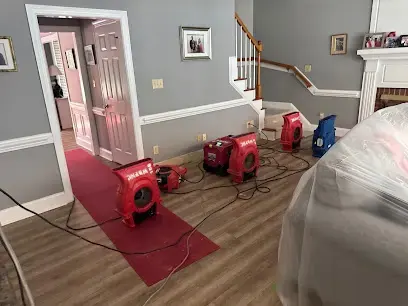
What to do first about structural drying in Chapel Hill
- 1
Stop the source
Drying cannot start while water is still coming in. Close valves and cover roof openings.
- 2
Get standing water out
Extraction comes before drying, since removing liquid water is far faster than evaporating it.
- 3
Keep the house closed
Close windows in humid weather so the dehumidifiers dry the house, not the outdoors.
- 4
Leave the equipment running
Do not switch off air movers or dehumidifiers overnight. Drying runs around the clock.
How structural drying is handled in Chapel Hill, NC
Structural drying is the core of every job. These are the four steps, and the last one is the one that ends the job.
- 1
Map
The tech who does the walkthrough maps moisture with pinless meters and thermal imaging before any equipment goes down.
- 2
Extract
The extraction crew pulls standing water with truck-mounted extraction, so the water leaves the house instead of moving to the next room.
- 3
Dry
The drying team sets air movers to each room's evaporation load and runs LGR dehumidifiers, or desiccants on Class 4 materials.
- 4
Verify
Crews record readings every day and pull equipment only when wet materials sit within 2 to 4 points of a dry reference.
What does structural drying and dehumidification cost in Chapel Hill, NC?
In Chapel Hill, NC, structural drying typically runs $1,200 to $6,000 or more, depending on the class of the loss, how many rooms and levels are wet, whether hardwood, plaster or crawl-space framing is involved, and how many days of equipment the readings call for.
Class 1 or 2, one area
$1,200 to $2,500
- Air movers and LGR dehus
- Moisture mapping
- Daily logs
Several rooms or Class 3
$2,500 to $4,500
- Wall cavity drying
- Ceiling drying
- Psychrometric readings
Class 4: hardwood, plaster
$4,500 to $6,000+
- Floor drying mats
- Desiccant dehumidifiers
- Extended monitoring
Ranges move with the water category, the square footage, the material class and how fast drying started. For a planning number, try the Chapel Hill water damage cost calculator.
Structural drying is what separates a finished dry-out from a cosmetic one. Surface water leaves quickly, but drywall, framing, subfloor and wood floors hold water inside for days. In Chapel Hill the old homes near downtown make this harder: plaster walls, heart pine and old-growth oak floors, and thick trim are dense materials that give up water slowly and crack if they are dried too hard.
How a structural dry-out is set up
- Moisture mapping with pinless meters, pin meters and thermal imaging
- A dry reference reading taken from unaffected material in the same house
- Air movers placed to the evaporation load of each room
- LGR dehumidifiers sized to the space, or desiccants for Class 4 materials
- Floor drying mats on hardwood and injection drying for wall cavities
Class 1 through 4
The IICRC S500 standard sorts losses by how much water was absorbed and how hard the materials are to dry. Class 1 is a small area with low-porosity materials. Class 2 is a whole room with wet carpet and walls. Class 3 means water came from above and soaked ceilings and walls. Class 4 is dense material such as hardwood, plaster, concrete and crawl-space framing, which needs lower humidity and more time.
The drying goal
Equipment leaves on readings, not on a schedule. The drying team pulls it when wet materials read within 2 to 4 points of the dry reference, and the daily psychrometric log shows the progress for the claim file.
Drying time in Chapel Hill homes
- A contained Class 1 or 2 loss: usually three to five days
- Hardwood and plaster: often five to seven days or more
- Crawl-space framing: four to seven days with the vents closed
- Humid summer weather: the space stays closed so dehumidifiers win
The EPA's indoor air quality pages explain why moisture left in a structure matters, and the National Weather Service flood safety page covers the storms that start many dry-outs. See water extraction for the step before drying, and crawl space water damage for drying under the house.
Where the structural drying crews work
The Chapel Hill restoration crew covers the whole town and Carrboro, from Franklin Street, Northside and Glen Lennox to Timberlyne, Southern Village, Meadowmont and Governors Club, across ZIP codes 27514, 27516 and 27517.
See every neighborhood and ZIP codeRelated water damage services in Chapel Hill
Structural Drying and Dehumidification questions from Chapel Hill homeowners
Straight answers about structural drying in Chapel Hill and Carrboro.
What is structural drying?
It is drying the building itself, the framing, subfloor, drywall and wood floors, not just the surface. It uses air movers, dehumidifiers and daily moisture readings until materials reach the drying goal.
Why not just open the windows and run fans?
In humid Chapel Hill weather, outside air is often wetter than the air inside a closed, dehumidified room. Fans alone move moisture around. Dehumidifiers remove it.
Can hardwood floors be saved?
Often yes, with floor drying mats and patience, if drying starts before the boards cup badly. Heart pine and oak in older homes dry slowly and are dried gently to avoid cracking.
How do I know the house is really dry?
The drying log. Readings on the wet materials are compared with a dry reference in the same house, and equipment comes out when they are within 2 to 4 points.
Is the equipment loud?
Air movers and dehumidifiers make steady fan noise and run day and night. It is temporary and usually lasts three to five days on a contained loss.
What is the IICRC S500?
It is the industry standard for water damage restoration. It covers inspection, water categories, drying classes, equipment setup and how the result is verified.
Structural Drying and Dehumidification in Chapel Hill? Get the drying started today.
Every hour of standing water pushes it deeper into subfloor, drywall and framing. The Chapel Hill drying team works around the clock.